Our policy, stated plainly
This program is for adult self-reflection. Children and students are never assessed, numbered, or labeled.
A parent or teacher explores their own habits, motivations, and reactions. We do not give the adult instrument to a child or teenager. We do not invite an adult to infer a young person’s type. We adopt an adults-only boundary throughout this program.
This is our program’s ethics policy. It is not a claim that every author or researcher takes the same position, and it is not a claim of legal protection.
What young people receive instead
At home, a child gets an adult who is paying closer attention to their own responses. Family conversation cards invite people to listen without scoring, fixing, or assigning a category. Anyone can pass.
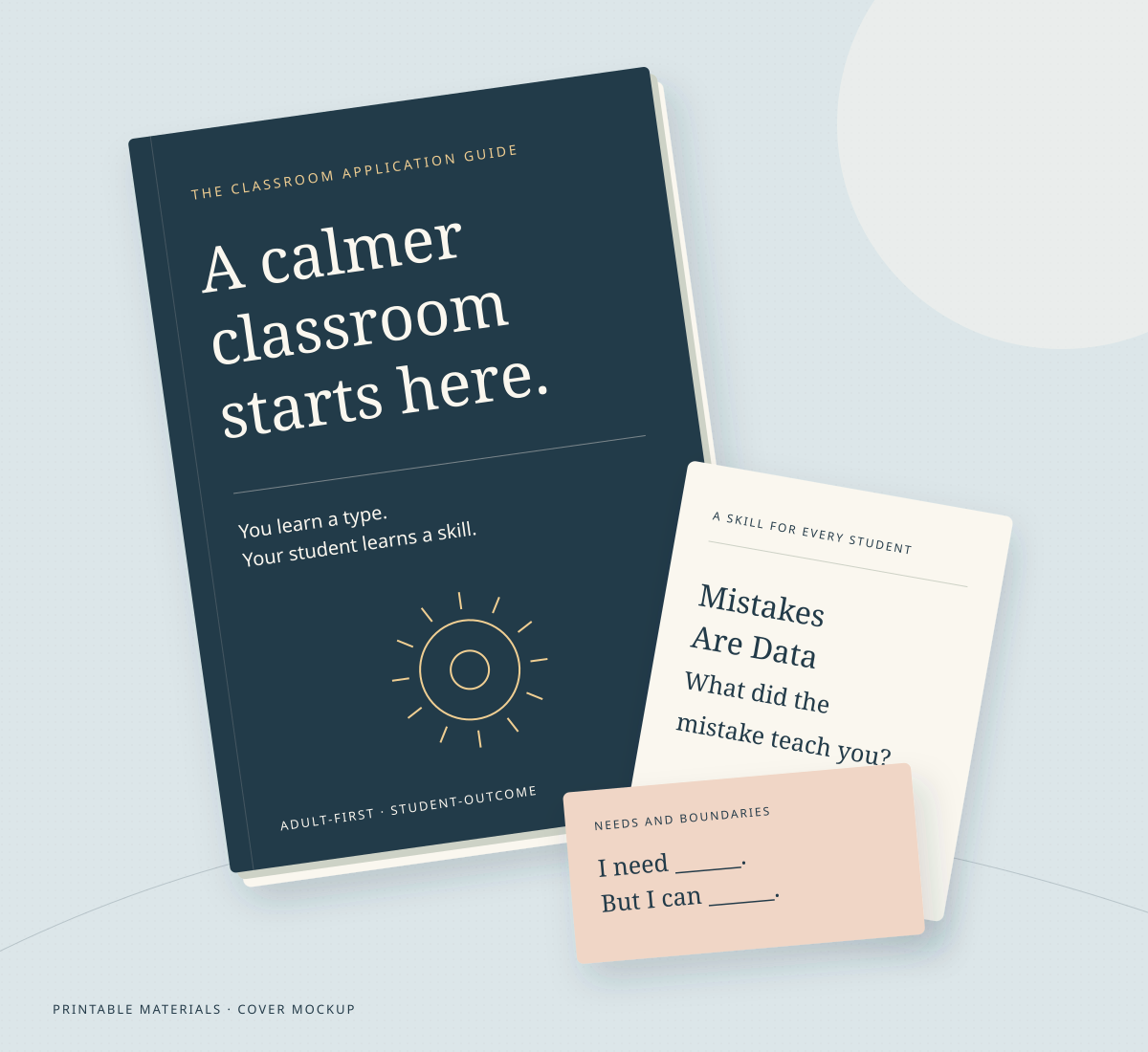
In the classroom, students practice skills such as learning from mistakes, naming needs, describing feelings, and speaking up respectfully. The student lesson text does not name the Enneagram, an adult type number, or a personality label. Adult teaching notes stay with the teacher.
Why we adopt this boundary
We want adults to use reflection on themselves, while leaving young people room to develop without a personality category imposed on them. Guidance about children in this field varies in scope and age boundaries. Our choice is to use this framework only with adults.
The source materials reference guidance from Elisabeth Bennett, David Daniels, and Enneagram Paths. Those references explain the background to our adopted policy; they do not establish an endorsement of this program or a unanimous professional consensus.
The framework has limits
The Enneagram has “mixed evidence of reliability and validity.” Hook et al. (2021), Journal of Clinical Psychology, reviewed the literature in The Enneagram: A systematic review of the literature and directions for future research (doi: 10.1002/jclp.23097).
We offer structured adult self-reflection, not a clinical assessment, diagnosis, or scientifically validated instrument. We do not use it for decisions about students. No endorsement by CASEL or any clinical organization is claimed.
What we collect
We collect no student data and no child data at all. Adult instrument responses remain in the downloaded materials, with the adult. Do not submit identifying details about a child or student through either website.
All products are self-serve digital materials. School staff lead parent nights. Staff sessions may be led by school staff or a facilitator arranged by the purchasing school. The operator provides no live delivery.