Student EnneagramAdult-first. Student-outcome.
The Teacher Starter Kit

Know your pattern. Choose your response.

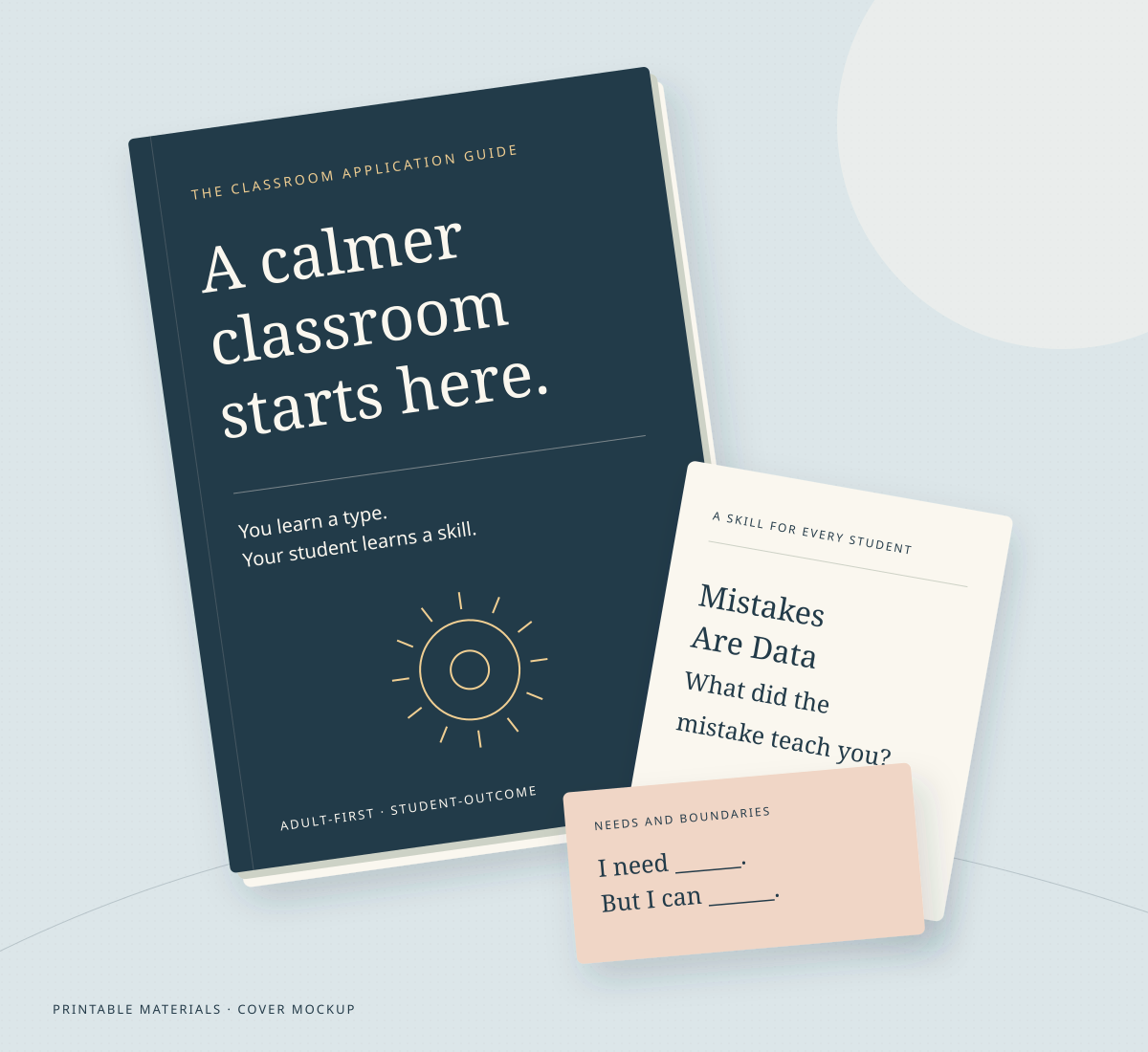
A standalone classroom guide for the teacher who wants to understand their own reactions. Nine adult-pattern sections, practical adjustments, and nine student skill lessons that never label a child.

Product preview of the classroom application guide with skill lesson pages
Digital materials. Print them, or read at your own pace.
The author behind the approach

Meet Sarah Dutton Waxman.

Sarah is a former educator of 10 years and a certified Enneagram coach. Her adult-first thesis asks teachers, parents, and administrators to understand themselves first so they can understand the child in front of them.

“A better you is a better them.”

— Sarah Dutton Waxman

Visit Sarah’s website

The Student Enneagram: The Secret to Leveling-Up Our Kids at Home & in the Classroom

Sarah’s book helps adults become self-aware so they can understand their students through observation of behavior, rather than diagnosis or labeling of a student.

This program’s classroom materials build on that adult-first thesis. Our never-type-minors rule consistently extends it: we never assess, number, or label a student.

Published July 19, 2022 by That's A Big Idea, LLC · 180 pages
ISBN-13: 979-8986471402 · ASIN: B0B6SDX5ZF

Get the book

The book that started this work — The Student Enneagram by Sarah Dutton Waxman. Same adult-first approach, 180 pages, in print.

Get the book on Amazon
What is in the download

You learn about yourself. Your student learns a skill.

Read at your own pace. Each teacher-pattern section describes classroom habits, a failure mode, three adjustments, and what happens under pressure.

The student lessons teach useful skills in ordinary language. Their student-facing text contains no Enneagram vocabulary, type number, or adult pattern label.

Our policy: students are never typed or assessed.

Printable PDFs + accessible HTML

  • The full Classroom Application Guide
  • Nine lessons with elementary and secondary adaptations
  • The 45-item adult reflection instrument with scoring instructions
  • The adult-first ethics policy
  • A ZIP bundle containing the PDFs and HTML editions

Licensed for one teacher’s classroom. No account, course, or live session is required.

Adult-facing sample

A teacher-pattern chapter, as written.

This section is about the adult teacher. It is not a description of a student.

Type 1 — The Reformer

The classroom look. You run a fair, orderly room. Routines are clear, expectations are explicit, and students know exactly what "done well" means. You grade with rigor and return work promptly with real feedback. Colleagues see you as the one who holds the standard.

The failure mode. The gap between "what is" and "what should be" is always visible to you, so your default commentary tilts negative. Your students hear far more about what was missing than what worked. Your inner critic, pointed at yourself, leaks out as a critic pointed at the room. You may also teach students to fear mistakes rather than use them, because your own relationship to error is tense.

The students you struggle with most. The corner-cutter, the careless one, the student who shrugs at sloppy work. They irritate you because carelessness is exactly what your inner critic fears most in yourself. The student who says "good enough" out loud is saying the sentence you refuse to let yourself say.

Three concrete adjustments.

  1. For every correction you give, add one specific, genuine statement of what worked. The ratio matters more than the precision: one "what worked" before every "what to fix."
  2. Rename your standards for students as "the goal we are working toward," not "the rule you broke." Aim language at the standard, not the child.
  3. Grade one assignment this week for growth only — note what improved since the last attempt — and give no error marks on it at all. Watch what that does to the room.

Stress signature. Under year-end pressure you tighten. Standards ratchet up, the critical voice gets louder, and you may become rigid about procedures precisely when students need flexibility. You mistake being hard on yourself for being good. The tell: you keep a list of everything still undone and cannot see the list of what you finished.


Real lesson previews

A skill lesson. No type language.

Two full plans, each with its selected age adaptation. The adult mapping note is excluded from these student lesson previews; the instructional prose is verbatim.

K–5 classroom version

Mistakes Are Data

Objective. Students learn that a mistake is information they can use, not a mark against their worth.

Materials. A short story or anecdote where a character fails and tries again; paper and pencils for the youngest; nothing else.

20-minute run-of-show.

  1. (3 min) Open with a question: "Have you ever messed up and felt terrible about it? Raise your hand if yes." Nearly every hand goes up. Name it: "That feeling is normal."
  2. (7 min) Tell or read a story where a character fails at something, feels bad, and tries again — and the second try is better because of the first failure. Pause before the ending and ask: "What did the mistake teach them?"
  3. (7 min) Turn to the students: each one thinks of a "useful mistake" — one they are actually glad they made because they learned from it. Draw or write it.
  4. (3 min) A few volunteers share. Close with the line: "A mistake is data. It tells us what to try next. It is not a grade on who you are."

K–5 version. Use a picture book or a short cartoon. Afterward, have each child draw a picture of their "useful mistake" with a caption: "I learned ______." Display them, or keep them private if the child prefers. Language stays concrete: "Your eraser is a tool, not a punishment."

6–12 classroom version

Needs and Boundaries

Objective. Students learn to name what they need and to say no without being unkind.

Materials. Index cards or small slips of paper; a pen for each student.

20-minute run-of-show.

  1. (4 min) Define both words plainly: "A need is something you require to be okay. A boundary is the line that protects what you need." Give one example of each from adult life.
  2. (6 min) Practice asking: each student writes one thing they need help with this week, then asks a partner for help with that exact thing. The partner practices answering honestly — yes or no.
  3. (6 min) Practice saying no kindly: model the three-part sentence "I can't do that, because I need ______, but I can ______." Students try it in pairs with low-stakes asks.
  4. (4 min) Debrief: "What was harder — asking, or saying no? Why?" Close: "Taking care of yourself is not selfish. It is how you stay able to be kind."

6–12 version. Discuss the difference between being nice (pleasing everyone) and being kind (honest and caring). Have students write one boundary they need with a friend, a family member, or a device, and practice saying it in a single sentence. Discuss what it costs to say no, and what it costs not to.

A practical starting point

Bring more awareness into tomorrow.

The Enneagram has “mixed evidence of reliability and validity” (Hook et al., 2021, Journal of Clinical Psychology). These materials are nonclinical and not a validated assessment. They offer structured adult reflection and ordinary classroom skill practice.

Read the adopted ethics policy. We collect no student or child data.

Reaching families or more staff? Compare the parent-night kit, facilitator materials, and site license.

For home, explore the $29 Parent Guide + Cards.

Teacher Starter Kit

$49 one-time purchase

Self-serve digital download · One teacher’s classroom

Purchase terms · Need materials for your school?

Keep noticing

A little space to reflect.

Join the inquiries list for information about school materials. Adult email addresses only.